News
Emeritus Professor James Warren wins Best Book on History
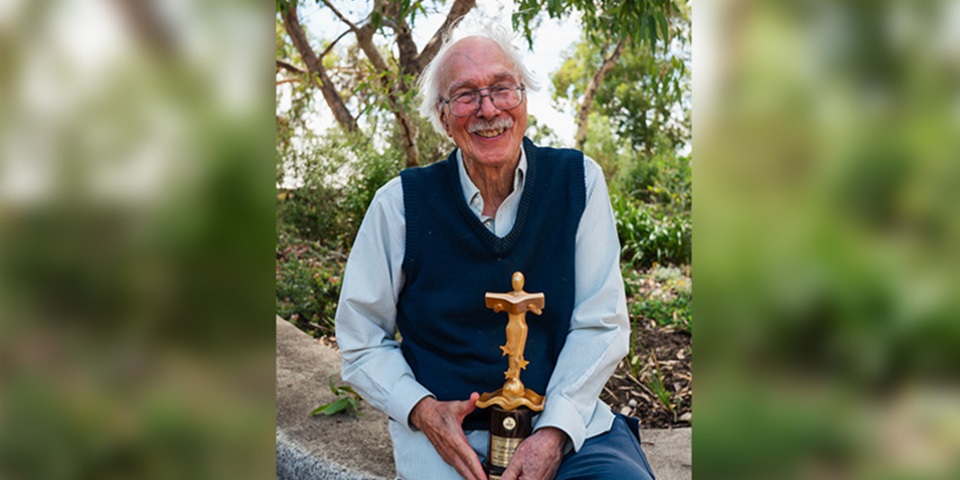
James Warren, Emeritus Professor of History, was awarded Best Book on History at the 43rd Philippine National Book Awards for his book Typhoons: Climate, Society, and History in the Philippines.
With over 50 years of service at ÍíÒ¹¸£ÀûÍøÕ¾, Professor Warren is an Ethno-Social historian who has dedicated much of his career to interdisciplinary research about aspects of human-environment interaction in Maritime Southeast Asia.
His book received the award for its deep analysis of the root causes, dynamic pressures and long-time formations behind typhoons and other natural disasters like floods, landslides, and storm surges - providing unique insights into the cultural and ecological history of the Philippines over five centuries.
Professor Warren describes the book and the award as a milestone in his career.
“The transdisciplinary methodology that lies behind the book perfectly exemplifies the historical theory and practice that I've attempted to develop ever since I came to Murdoch, 50 years ago,� he said.
“Receiving this award is a wonderful recognition of my work and influence in teaching and writing about aspects of the environmental and social history of the Philippines and Maritime Southeast Asia.�
Deborah Gare, Pro Vice Chancellor of Law, Arts and Social Sciences, congratulated Professor Warren on his achievement.
“We are delighted that the work of Jim Warren, an esteemed colleague, continues to receive the international recognition that it deserves,� she said.
“Over a lifetime of scholarship, Jim has contributed significant new knowledge to Australia and the region. He has done so while being a remarkable human being -empathetic, insightful, and caring of others.
“In short, Jim deserves this and every other acknowledgement that he has received.�
An over 40-year-long project, Professor Warren said his book was partially inspired by his on-the-spot experience in the Philippines, where he repeatedly witnessed extensive flooding firsthand.
“When I first started my archival research at the Philippine National Archive in 1972, I often had to leave the building early to avoid the daily street flooding during the rainy season,� he said.
“By 1982, the cyclonic storms had become larger and more intense, and one day, a storm arrived early and flooded everything in the downtown area of Manila near the archive.
“I had to pay a brave Jeepney driver handsomely to convince him to drive me back to where I was staying, and the usual 40-minute commute instead took six hours as I sat in front, helping guide him through the ever-rising flood waters.
“I was convinced then that something had to be written about the character and impacts of the changing weather patterns, and how the lingering psychological and health consequences of such typhoons and floods unduly affected women, children, the elderly and infirm in Manila and the provinces.�
Another foundational moment in the making of the book came when Professor Warren discovered unpublished meteorological records that had survived the destruction of Manila during World War II.
“The most important primary sources came from the records of the Jesuit meteorologists in the Philippines - who helped pioneer the science of meteorology in Asia - chronicling the annual storms in documents, letters and books about big weather and the colonisation process across the centuries,� he said.
“As the Japanese withdrew from Manila in 1945, they dynamited the library of the Manila Observatory, destroying over 100,000 volumes.
“Miraculously, just days prior, some brave, dedicated Filipino staff at the observatory took it upon themselves at great risk to bury some of those Jesuit records.
“Those surviving fragmented records proved invaluable, enabling me to create an evidentiary scaffolding to begin framing certain parts of the book, as well as certain chapters.�
Professor Warren hopes the book will deepen regional understanding of the changing character and patterns of the storms and their socioeconomic impacts, with early responses suggesting it has.
“There's been a huge public response to the book; it's helped Filipino people understand how and why their lives perhaps could have been otherwise than what they are now,� he said.
“The conclusions in the book are asking a dominant, inordinately wealthy political minority to change, to shift to an ecologically sustainable culture and equitable society and to work with nature and each other.
“People who are the heads of major government departments in the Philippines have written to me thanking me for framing the conclusions in my book about an ethic of sustainable development and reform of human institutions in that way.�
Professor Jacqueline Lo, Director of the Indo-Pacific Research Centre, commented on the impact and importance of Jim’s work.
“We recently received a letter from the Philippine Disaster Resilience Foundation acknowledging the importance of Typhoons to their work,� she said.
“We are so lucky to have Jim as a member of the Indo-Pacific Research Centre.
“His work has not only influenced the discipline of Southeast Asian history and inspired generations of scholars, but it has also influenced artistic production and policy in the region.�
News
Emeritus Professor James Warren wins Best Book on History
Posted on